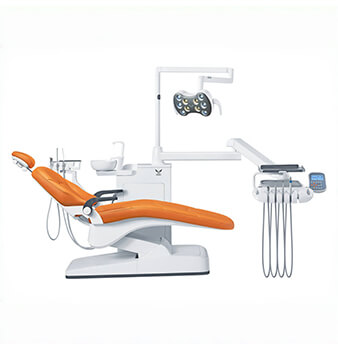
B2B buyers should compare dental unit spittoon types by four practical factors: how the bowl moves, whether it detaches, how staff reach the surrounding area, and how the assembly connects to rinse and drainage functions. Material matters, but a ceramic label alone does not define the working configuration.
For an importer, distributor, or clinic project, the safest specification names the complete Dental Unit model and then freezes the spittoon subsystem, its interfaces, and the checks used to approve it. This prevents a familiar product name from hiding differences that affect patient access, room layout, cleaning access, installation, or replacement planning.
Shortlist the complete chair from the Gladent dental unit range before writing the spittoon line in the RFQ. The same bowl description can sit within very different unit layouts, so model identity and ordered configuration must stay together.
A dental unit cuspidor is more than the visible receptacle. The order may also involve a support arm or mounting point, movement stops, a removable interface, bowl-rinse and cup-fill controls, waste routing, water connections, and access for inspection. Buyers should record each item separately because the presence of one does not prove the specification of another.
Start with a boundary statement: identify what belongs to the spittoon assembly, what belongs to the treatment unit, and what belongs to the clinic or vehicle installation. For example, a rotating ceramic bowl is a product fact; pipe routing and site drainage are installation facts. A quotation that blends those facts into one sentence is difficult to compare and harder to inspect.
Use the same boundary when discussing options. If a rinse control, waste connection, removable strainer, or spare component is required, ask whether it is included in the quoted unit, supplied separately, or expected from the installer. Do not infer compatibility from a photograph or from the word standard.
For procurement, useful types are functional configurations rather than marketing labels. The following comparison turns the visible design into questions that can be answered in a quotation and checked on a reference unit.
| Configuration characteristic | Buyer decision | Verification point |
| Inward-rotating bowl | Confirm the patient can reach it without obstructing the operator or nearby equipment. | Check direction, usable travel, stopping position, and clearance on the ordered model. |
| Detachable bowl | Decide whether removal is part of the approved cleaning, inspection, or service process. | Demonstrate removal, secure reinstallation, fit, and a post-reassembly function check. |
| Non-detachable or fixed installation | Confirm staff can still reach all required surfaces and service points. | Inspect access with the chair, delivery system, and assistant area in normal positions. |
| Ceramic bowl | Treat the material as one specification field, not as evidence of the entire subsystem. | Approve finish, fit, movement, mounting, and replacement identification separately. |
Rotation and detachability solve different problems. Rotation changes where the bowl sits during treatment and patient rinsing. Detachability changes how the bowl can be removed and returned to service. A product may have one feature, both, or neither, so the RFQ should never use the terms as substitutes.
An inward-rotating dental spittoon can bring the bowl closer when it is needed and return it toward the unit afterward. The relevant question is not whether it rotates, but whether the actual movement works within the intended operatory. Ask the supplier to demonstrate the occupied area at both end positions and to identify any contact risk with the chair, delivery arm, assistant instruments, cabinetry, or wall.
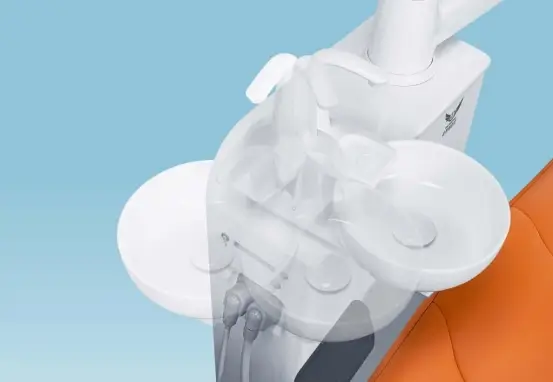
A stated 90-degree movement describes an angle, not the full clearance envelope. Reference-unit review should therefore use the chair and nearby modules in the positions expected during treatment. Project buyers can then compare the result with their room plan instead of relying on a single top-view dimension.
A detachable dental spittoon can give staff direct access to the bowl away from the unit. That benefit depends on a controlled removal and return process. Ask who is expected to remove it, which parts come away, how orientation is controlled, and what check confirms correct seating after reinstallation. The supplier should identify replacement components by model rather than by appearance alone.
Do not convert detachability into an unsupported hygiene claim. Cleaning agents, contact times, disassembly frequency, and infection-control procedures belong to the buyer’s validated protocol and the applicable instructions. Procurement can verify physical access and reassembly without promising a clinical outcome.
A complete specification should separate the bowl from every function that feeds it or carries waste away. The buyer, supplier, and installer need a common interface record.
Suction is a separate clinical subsystem. A spittoon bowl does not establish suction performance, and a suction specification does not define the bowl. Keep the two sections separate in the RFQ, then check how their hoses, controls, and service access share the same physical area.
Gladent dental unit uses different spittoon configurations across its product range. The GD-S450 floor-fixed dental unit has a ceramic spittoon that rotates 90 degrees inward. For a fixed treatment room, that fact gives the buyer two measurable checks: confirm the inward movement within the planned chair-side clearance and approve both end positions on the reference unit.
The GD-200 integral dental unit also uses a ceramic spittoon with 90-degree inward rotation. A distributor comparing it with the GD-S450 should therefore avoid treating the shared angle as proof that the complete layouts are identical. Inspect clearance, access, the relationship to adjacent modules, and the exact quoted scope on each model.
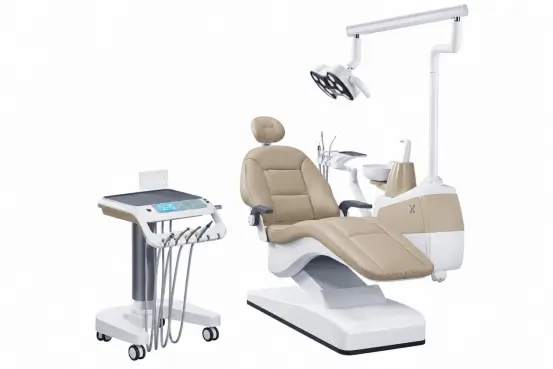
The GD-S350 Mobile Trailer Type takes a different approach: its ceramic spittoon is detachable. That configuration makes removal and return-to-service steps central to the buyer’s inspection. For a mobile configuration, also confirm the bowl’s stored and operating positions, secure fit after repositioning of the unit, included loose parts, and packing identification.
An effective RFQ turns each preference into a field that survives quotation, order confirmation, production, and inspection. Use exact model numbers and avoid wording such as high-quality spittoon or easy-clean bowl. Those phrases do not define movement, removal, interfaces, included parts, or acceptance criteria.
If the order includes several unit models, repeat the spittoon section for each one. The technical annex should preserve model-level differences, especially when an order mixes fixed-room and mobile-trailer units.
Use one approved unit as the configuration reference. Operate the bowl through its intended movement, remove and reinstall it when applicable, and inspect fit, finish, stops, access, included parts, rinse controls, and visible connections. Record the accepted model and revision with photographs or video in the procurement file.
For the detachable example, review the GD-S350 mobile-trailer dental unit and ask for the removal and reassembly sequence to be included in the reference-unit demonstration. The acceptance record should name the parts that detach and the check performed after the bowl is returned.
For the remaining quantity, sample against the same record. Check model labels, movement direction, secure stops, detachable interfaces where ordered, included loose parts, and packing identification. Commissioning at the destination must still confirm site utilities and waste connections; pre-shipment inspection cannot replace the installer’s final checks.
The best dental unit spittoon types are the configurations that match the intended workflow and can be described, demonstrated, and inspected. Specify movement, removal, access, connected controls, waste and water interfaces, included parts, and site responsibilities as separate fields. Then approve one reference unit before the bulk order proceeds.
For a model-level review, send Gladent your spittoon configuration RFQ with the destination market, quantity, selected models, installation environment, and required movement or removal method. Ask for all confirmed fields to appear in the quotation and order documents.
No. Ceramic identifies the bowl material, but the buyer still needs to define movement, detachability, mounting, included rinse controls, waste and water interfaces, service access, loose parts, and acceptance checks. Keep the material field in the RFQ, then add the functional and installation fields that make the configuration verifiable.
They address different tasks. Rotation changes the bowl’s position for patient reach and chair-side clearance. Detachability allows the bowl to be removed and reinstalled. Select either feature only after the supplier demonstrates how it works on the exact Dental Unit model and your team confirms the corresponding operating or cleaning procedure.
No. The bowl, rinse and waste path, and suction system are separate specification areas even when they occupy the same assistant-side zone. Define suction functions and interfaces in their own RFQ section, then inspect shared access and hose routing on the assembled reference unit.
Request a model-specific quotation, annotated configuration view, included-parts list, interface information for the installer, reference-unit demonstration, and pre-shipment acceptance record. When several models are ordered, require a separate spittoon line for each model so that rotation, removal, and included components cannot be mixed.
 No. 1, No. 2, Fenggang Industrial Zone, Lianhe, Luocun, Shishan Town, Nanhai District, Foshan City, China
 Call us now:+86-757-81267151