For EU importers, sourcing dental units from an overseas manufacturer now involves more than comparing price, chair configuration, and delivery time. Since May 28, 2026, four EUDAMED modules have become mandatory for the relevant actors and authorities: Actor Registration, UDI/Device Registration, Notified Bodies & Certificates, and Market Surveillance.
That makes product identity harder to treat as a last-minute paperwork issue. Before a bulk order moves into production, the legal manufacturer, model, label, applicable CE documentation, and UDI information need to describe the same device.
For an EU buyer comparing a dental unit manufacturer in China with other overseas suppliers, early verification can prevent a small documentation mismatch from becoming a shipment, relabeling, or launch problem later.
EUDAMED is part of the EU MDR framework, but it is not a product certificate and does not replace CE marking. Its role is different: the system connects economic operators with device and UDI information, certificates where applicable, and other regulatory data.
For procurement teams, the practical point is simple. A quotation, device label, EU Declaration of Conformity, UDI data, and EUDAMED record cannot be treated as separate pieces of information. They need to line up before the product enters the EU market.
Under the EU MDR, an importer verifies that the device carries CE marking, that an EU Declaration of Conformity has been drawn up, that the manufacturer and authorised representative are identified where required, that the device carries the required labeling and instructions, and that a UDI has been assigned where applicable. Importers also verify device registration and register their own economic-operator details.
For a non-EU manufacturer, an authorised representative in the Union is part of that regulatory chain.
This changes the supplier conversation. A dental unit supplier saying “CE available” has not answered the buyer’s real question. Procurement needs to know whether the documentation applies to the exact model and configuration being quoted.
Once those economic-operator roles are clear, private-label orders add another issue: whose name and trademark will appear on the device?
Private labeling can affect regulatory responsibilities, so the arrangement needs to be settled before logos, labels, and manuals are finalized.
Under MDR Article 16(1)(a), an importer or distributor that markets a device under its own name or trademark can take on manufacturer obligations. An exception applies where an agreement keeps the original manufacturer identified on the label and responsible for the manufacturer requirements under the MDR.
In that Article 16(1)(a) arrangement, the July 2026 MDCG position on UDI assignment keeps UDI-DI assignment with the manufacturer. A third party may handle practical UDI activities on the manufacturer’s behalf, but the UDI remains linked to the company acting as the manufacturer.
For an OEM dental unit project, settle the legal-manufacturer arrangement first. Branding, UDI work, labeling, manuals, and packaging can then follow a clear responsibility structure.
Once the regulatory roles are settled, the next risk is a gap between the approved sample, the paperwork, and the production order. Dental units are often supplied with different voltages, accessories, suction arrangements, lights, upholstery, or branding options. A model name alone does not capture all of that.
The purchase order needs to turn the approved sample into a written, repeatable configuration.
Before a bulk dental unit order enters production, confirm:
Importers keep a copy of the EU Declaration of Conformity and, where applicable, relevant certificates. The MDR also requires importers to verify device registration.
The commercial effect is easy to overlook. If the sample carries one reference while the label or final documentation carries another, the issue can trigger extra checks, relabeling, distributor onboarding delays, or a postponed launch.
Once the product and documentation line up, the next comparison is financial rather than regulatory.
Factory price is visible from day one. Service cost usually is not.
Installation, technician time, spare-parts inventory, training, warranty handling, and downtime all affect the real procurement cost. Saving a small amount per unit has little value if a routine component later takes weeks to replace or the local installer discovers an unconfirmed utility requirement.
When comparing a dental equipment supplier, ask what needs to happen after the unit leaves the factory. Installation information, technical support, spare-parts planning, warranty handling, and repeat-order consistency all influence the distributor’s margin.
Regulatory checks and a competitive landed cost still do not answer one important question: is this the right dental unit for the clinics you actually sell to?
General practices, specialist clinics, tenders, and dealer networks do not value every function equally. Hygiene may lead one project. Chair movement, lighting, operating simplicity, or price may matter more in another.
For distributors serving clinics that place waterline and suction hygiene high on the buying list, the GD-S800 Disinfection Dental Unit offers a clear application. It combines one-click full-waterline disinfection, nine memory positions, a dual-bottle water system, and disinfection functions for the waterline and high- and low-suction circuits.
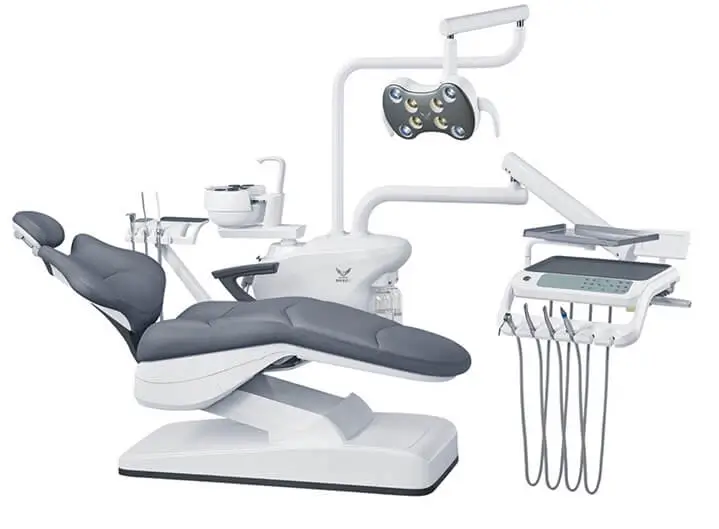
For the clinic, those functions bring more of the hygiene workflow into the treatment unit itself. For the distributor, that creates a more specific sales position than simply offering a higher-spec chair.
It still needs to fit the customer’s cleaning protocol, staff routine, maintenance plan, and budget. If a clinic will rarely use the extra functions, paying for them adds little commercial value.
Hygiene is not the deciding factor in every project. In some product ranges, positioning, chair movement, and lighting carry more weight.
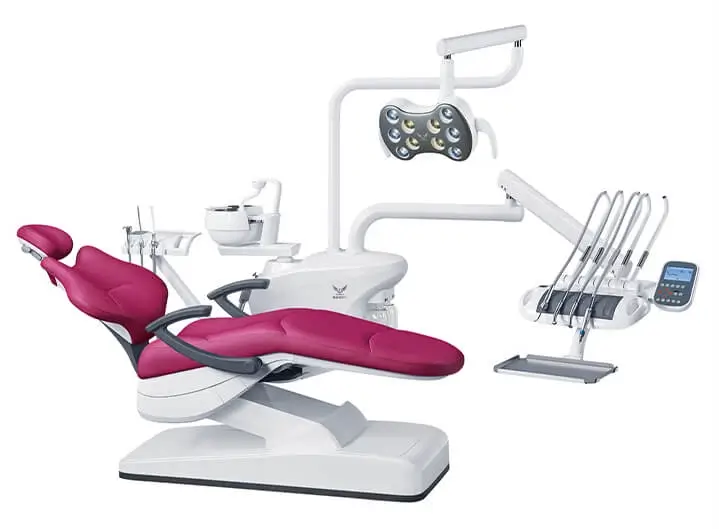
The GD-S600 Hydraulic Dental Unit serves that different buying profile. It uses a hydraulic drive system and combines automatic full-waterline disinfection with a 10-hole tri-color oral light.
The purchasing question is not whether hydraulic drive is automatically “better.” It is whether the movement and treatment setup fit the clinic segment and price point.
A distributor selling to clinics that value hydraulic positioning and a more advanced treatment configuration may have a clear case for that model. In a price-sensitive general-practice segment, a simpler configuration may produce a better offer.
That is where a capable dental unit manufacturer adds value: helping the buyer match configuration to market demand rather than selling features for their own sake.
A sample can perform well and still become a difficult project if installation, delivery timing, or service responsibilities remain vague. For overseas procurement, the unit has to work within the customer’s room, local utilities, launch schedule, and service network.
These details also determine whether the first purchase can become a predictable repeat-order program.
Before production is frozen, confirm voltage and frequency, plug type, water, air, drainage, room requirements, optional accessories, and local installation responsibility.
Operating and maintenance information needs to match the purchased configuration. If local technicians require product-specific guidance, that conversation belongs before shipment rather than during the first installation.
The timeline deserves the same attention. Sample approval, document review, private-label artwork, production, and shipping all affect the final delivery date. A technically suitable dental unit can still be the wrong sourcing choice if it misses a clinic opening, tender deadline, or distributor launch.
Repeat orders bring another set of practical questions. Which components are model-specific? Which service parts make sense to stock locally? How are specification or component changes communicated between batches?
Gladent’s guide to consistent quality in bulk dental unit orders covers the same issue from the production side: the approved sample, written specification, production batch, test records, and shipment documents need to stay aligned.
For distributors, that consistency simplifies installation, technician training, spare-parts planning, and after-sales support. A reliable dental unit supplier does more than deliver the first order; it makes the next order easier to reproduce.
EUDAMED 2026 has made regulatory identity and device registration a more visible part of EU dental unit sourcing, but the buying decision remains practical. The legal-manufacturer arrangement needs to be clear, the device needs to match its documentation, the configuration has to suit the target clinics, and the importer needs a workable plan for installation, lead time, spare parts, and repeat orders.
That provides a stronger basis for comparing one dental unit manufacturer with another than factory price alone.
EU importers and distributors evaluating Gladent dental unit can send their destination market, expected quantity, preferred configuration, delivery target, and OEM or private-label requirements through the Gladent contact page to discuss model-specific requirements and request a bulk quotation.
A: No. EUDAMED is the EU medical-device database system, while CE marking indicates conformity with applicable EU requirements. Importers need to review both in the context of the exact device, together with the EU Declaration of Conformity, labeling, and UDI information where applicable.
A: Key items include the applicable EU Declaration of Conformity, manufacturer and authorised-representative details, labeling and instructions, and UDI/device information where applicable. The commercial review also needs the final configuration, utilities, installation requirements, spare-parts plan, and any OEM details.
A: Yes. Importers are among the economic operators required to register, and they also verify relevant device registration information.
A: It depends on the legal-manufacturer arrangement. Where an Article 16(1)(a) agreement keeps the original manufacturer identified on the label and responsible for manufacturer obligations, UDI assignment remains with that manufacturer.
A: Confirm the final model and options, applicable CE and UDI information, labeling, utilities, installation requirements, OEM details, spare-parts planning, written production specification, and delivery schedule. The approved sample and production order need to describe the same unit.
 No. 1, No. 2, Fenggang Industrial Zone, Lianhe, Luocun, Shishan Town, Nanhai District, Foshan City, China
 Call us now:+86-757-81267151