For an EU importer, distributor, or private-label buyer, purchasing a dental chair involves more than comparing functions and factory prices. The commercial quotation must match the manufacturer, device identity, approved configuration, labels, instructions, and applicable EUDAMED records.
As of May 28, 2026, four EUDAMED modules are mandatory: Actor Registration, UDI/Device Registration, Notified Bodies and Certificates, and Market Surveillance. The Market Surveillance module is used by competent authorities and the European Commission, while importers’ relevant obligations mainly concern actor registration and verification of device registration.
A buyer reviewing dental chairs for sale should therefore ask more than, “Does this model have CE marking?” A better question is:
Can the supplier connect every document to the exact model, options, voltage, and destination market stated in our order?
That model-level connection is the central issue. A document package may look complete, yet still fail to describe the actual unit entering the EU.
EUDAMED is now part of routine medical-device compliance. Importers must register in EUDAMED, while manufacturers enter the applicable UDI and device information. Distributors do not generally have to register in EUDAMED, although national registration requirements may still apply in individual Member States.
Importers and distributors also carry verification duties. They must check matters such as CE marking, required product information, labeling, and UDI assignment where applicable. Importers must keep a copy of the EU Declaration of Conformity and, where applicable, the relevant certificate for the retention period required by the MDR.
These checks should happen before the device is placed on the market. Finding a mismatch after a container arrives can lead to:
For a B2B buyer, compliance is not separate from purchasing. It is one part of the purchasing decision.
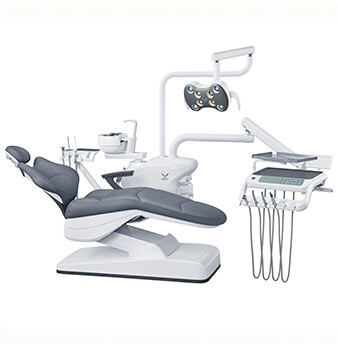
“Dental chair” is the phrase buyers commonly use in Google searches and supplier inquiries. In practice, however, a quotation may cover a complete dental treatment unit rather than only the patient chair.
A complete unit may include:
The quotation, specification sheet, product label, declaration, and inspection report should describe the same configuration.
ISO 7494-1:2018 specifies general requirements and test methods for stationary dental units, patient chairs, and combinations of both. ISO 7494-2:2022 addresses air, water, suction, wastewater, and related dental-unit connections. ISO 7494-2 does not provide test methods for the effectiveness of waterline biofilm control and applies to stationary units that are not used for oral surgery requiring sterile air and water supplies.
These standards are useful technical references, but they do not replace a model-specific MDR review. Device classification and conformity requirements depend on the intended purpose and final configuration, not merely the commercial name “dental chair.”
An EU-based company acts as the importer when it obtains an individual device from a non-EU manufacturer or supplier and places that device on the Union market for the first time.
A distributor makes a device available after it has already been placed on the market. For a given device, the EU entity that first places it on the Union market from a third country acts as the importer. Downstream economic operators that subsequently make the device available act as distributors.
The supply agreement should identify:
A distributor that purchases directly from a non-EU dental unit manufacturer should not assume it remains “only a distributor.” For those individual devices, it takes on importer responsibilities.
A professional document review should begin with the exact quotation, not with a general folder named “certificates.”
| Document or record | What the buyer should verify |
| EU Declaration of Conformity | Manufacturer, address, product identification, legislation, date, and signatory |
| CE marking records | Applicable conformity-assessment route and Notified Body information where required |
| UDI and EUDAMED information | Matching manufacturer, model, identifiers, and device records |
| Label and instructions | Authorised representative, importer details, warnings, voltage, and languages |
| Approved specification | Chair system, delivery layout, options, accessories, packaging, and revision number |
“CE certified” is common sales language, but CE marking is the more accurate professional term.
Not every dental chair or integrated dental unit follows the same conformity-assessment route. Buyers should request the current EU Declaration of Conformity and review the product identification, intended purpose, classification information, and Notified Body details where applicable.
Compare the manufacturer’s name and address across:
Model suffixes deserve attention. A GD-S800, a GD-S800 with added accessories, and another configuration sold under a private label should not be treated as interchangeable without checking the applicable records.
A broad certificate with no clear link to the quoted product is not enough for purchase approval.
For devices subject to the applicable registration timelines, the manufacturer enters the relevant UDI and device data. The importer registers as an economic operator, keeps its information current, checks that the device is registered, and verifies the required manufacturer or authorised representative data.
The practical test is consistency. The following records should point to the same product:
Small discrepancies should be corrected before production. A missing model suffix or an outdated manufacturer address may appear minor during quotation review, but it can create uncertainty about which device the file actually covers.
The importer is responsible for including its name, registered place of business, and contact address on the device, its packaging, or accompanying documentation. A downstream distributor must verify that the importer information is present before making the device further available.
Instructions and safety information must also meet the language requirements of the destination Member State.
When an order covers several European markets, translation and artwork approval can influence:
Approve the label and instruction version before the factory closes the cartons. Fixing it later is possible, but rarely efficient.
Gladent dental unit is a Foshan dental equipment manufacturer established in 2013. Its dental unit range includes hydraulic, integral, implant-type, disinfection, floor-fixed, mobile-trailer, and children’s units. Its products are CE approved and exported to more than 50 countries. EU importers still need to verify the Declaration of Conformity and any applicable certificate for the exact model and configuration.
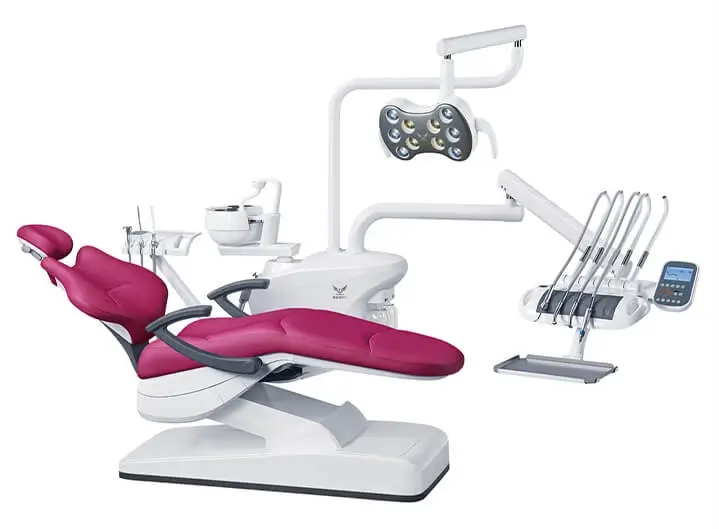
The GD-S600 hydraulic dental unit is described with a hydraulic drive system, automatic full-waterline disinfection, imported water and air pipes, and a 10-hole tri-color operating light. Its page also describes a butterfly-style metal backrest and self-lubricating hydraulic components.
The GD-S800 disinfection dental unit has a different product configuration. It is listed with one-touch full-waterline disinfection, nine memory positions, one-touch water, air, and power control, and a dual-bottle water system.
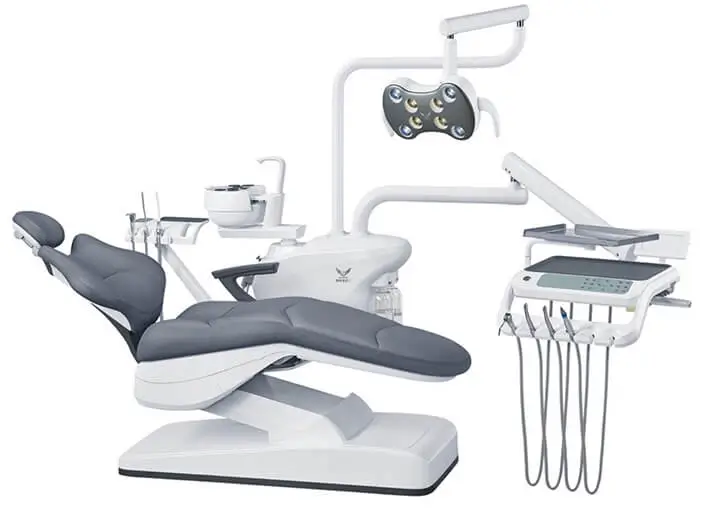
These features should not be copied into a purchase order as general Gladent specifications. The buyer should confirm which features belong to the selected model and which options have been added to the quotation.
Orders often change during negotiation. A distributor may request:
Each change should appear in the controlled specification, label review, inspection checklist, and applicable document package.
For the wider sourcing workflow—including supplier selection, sample orders, shipping, inspection, and after-sales planning—buyers can also review the Gladent guide to buying a dental chair from China. This creates a clear content path from general supplier sourcing to EU-specific compliance review.
The ex-factory dental chair price is only one part of the commercial decision.
An EU importer may also need to budget for:
When comparing dental chairs for sale, use the same commercial scope for every dental chair supplier. Compare the exact model, included accessories, voltage, label languages, Incoterm, packaging, warranty, and technical-support package.
A lower quotation may become more expensive when key accessories, documentation, or service items are missing.
There is also a long-term commercial issue. A distributor needs equipment it can support after the first installation. A competitive dental chair price has limited value when replacement tubing, valves, control boards, or upholstery parts cannot be identified quickly.
Before approving production or releasing the deposit, confirm:
Add the final configuration revision and label version to the purchase order. It is a small administrative step, but it prevents the factory, importer, and inspection company from working with different files.
A reliable EU dental chair import process begins before production. The buyer must connect the commercial offer with the correct device identity, CE marking route, UDI and EUDAMED information, approved labels, language files, and after-sales plan.
Price remains important, especially for distributors protecting dealer margins. However, the lowest dental chair price does not protect a business when the supplied configuration and compliance records do not match.
Send Gladent your destination country, target model, order quantity, voltage, and required options to request a model-specific document checklist and wholesale quotation for your EU market.
A: No. The importer should also check the EU Declaration of Conformity, manufacturer and authorised representative information, UDI where applicable, EUDAMED registration, importer details, labels, and instructions for the exact model.
A: No. Notified Body involvement depends on the device classification and conformity-assessment route. Buyers should review the intended purpose and final configuration rather than apply one rule to every dental unit.
A: Both have relevant duties. The manufacturer registers applicable UDI and device information. The EU importer registers as an economic operator, maintains its own information, verifies device registration, and checks the required manufacturer or authorised representative data. Distributors generally do not register in EUDAMED, although national rules may apply.
A: Translation, importer labeling, configuration review, inspection, documentation, and local service preparation can add cost. Buyers should compare total landed cost rather than only the factory quotation.
A: Pause the approval process and ask the dental chair supplier to clarify the model scope, option list, and applicable records. The quotation, specification, labels, and supporting documents should be consistent before the purchase order is released.
 No. 1, No. 2, Fenggang Industrial Zone, Lianhe, Luocun, Shishan Town, Nanhai District, Foshan City, China
 Call us now:+86-757-81267151