A cost-effective dental unit chair does not mean the lowest quoted price. A cost-effective dental unit chair means an integrated clinical system that supports reliable positioning, safe water and air delivery, efficient assistant access, stable lighting, patient comfort, and predictable service access during daily procedures.
The selection of the dental unit chair has an impact on the accuracy of the treatment, the workflow at the chair, the patient’s confidence and the risks of purchasing. ISO 7494-1 specifies the requirements and the relevant test methods for stationary dental units, dental patient chairs and combinations of dental units and dental patient chairs. This standard describes dental unit chairs as integrated clinical device categories with mechanical, electrical, ergonomic and document-related requirements.
1、Clinical stability should support precise treatment.
A chair base should resist shaking during scaling, restorative work, endodontics, oral surgery, and implant-related procedures. Stable lifting and reclining motion should protect operator control when instruments are active inside the oral cavity.
2、The backrest should support operator access.
A thin or contoured backrest can create better working space around the patient’s head and shoulders. Proper access can reduce unnecessary repositioning and help the dentist and assistant keep a cleaner four-handed workflow.
3、The operating light should provide usable clarity.
Illumination should be stable, shadow-reduced, and comfortable for long procedures. A dental light should help the operator distinguish margins, fluids, tooth structure, instruments, and soft tissue without frequent manual adjustment.
4、The delivery system should match the treatment mix.
A dental unit should place handpiece tubing, air-water syringes, suction controls, and control panels within a natural working range. A balanced delivery layout can reduce repeated reaching and help the operator maintain a consistent posture.
5、The waterline and suction design should support infection-control workflows.
Dental unit waterlines have narrow tubing and intermittent flow patterns that can promote biofilm formation. The CDC states that dental unit treatment water for routine care should meet drinking-water standards of ≤500 CFU/mL of heterotrophic water bacteria, and the CDC also advises consultation with the dental unit manufacturer for appropriate methods and equipment.
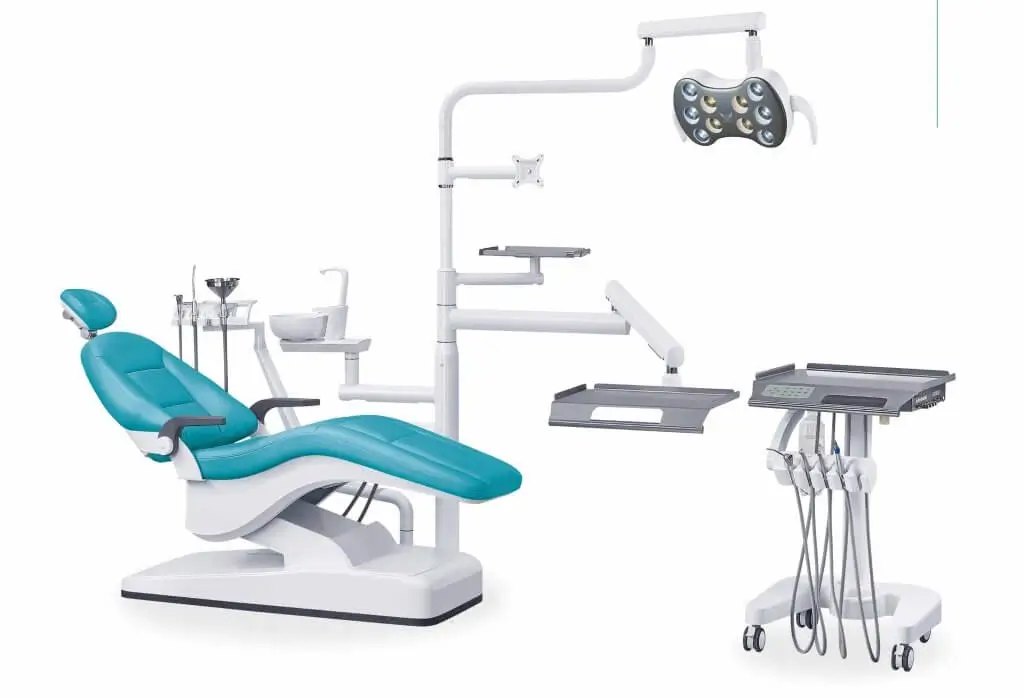
The purchase price of a dental unit chair is only one component of the overall investment that a procurement team needs to consider. The following factors need to be taken into account when calculating the delivery configuration, accessory requirements, the level of installation required, the required training, the availability of spare parts, the warranty offered by the supplier and the product documentation. A dental chair with a low purchase price can be very expensive if the delivery system does not fit in the dental clinic, if the suction is not sufficient or if the backrest of the chair blocks access to the patient during long treatments.
Evaluating a cost-effective dental chair in terms of total clinical value can help in determining the appropriate dental chair for clinical use. The total clinical value of a dental chair includes the value of the chair for performing a variety of procedures on a daily basis, the chair’s value for providing consistent and reliable operation for patients and dental staff, the chair’s value for infection control and other clinical applications, and the chair’s value for accessing dental chair services and support.
A hydraulic dental unit chair is often valued for smooth lifting, strong load performance, and stable movement under repeated use. A hydraulic system can be suitable for longer procedures, implant-related treatment, oral surgery, or high-volume general dentistry. Smooth motion helps prevent abrupt patient movement and helps the operator maintain instrument control.
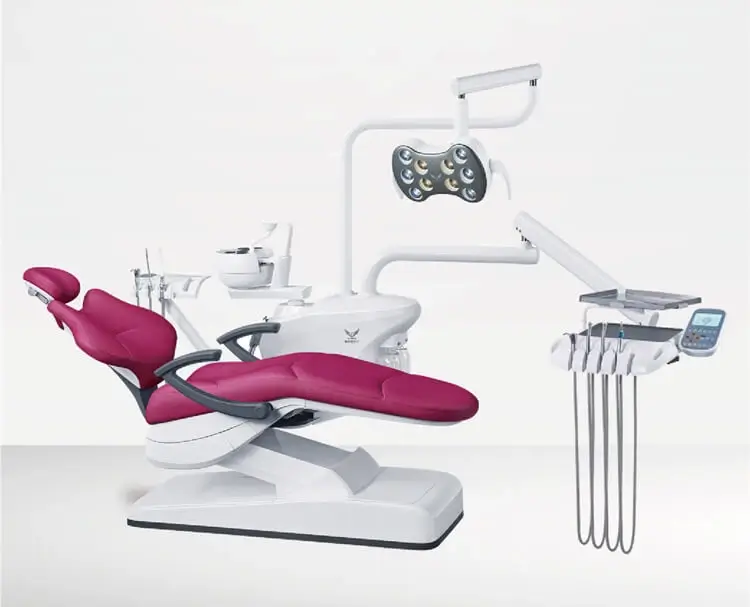
An electric dental unit chair often offers familiar control logic, programmable positions, and efficient daily operation. Electric positioning can support restorative dentistry, prophylaxis, endodontics, and routine examinations when motion precision and chairside convenience are priorities.
The chair drive system should be selected according to clinical load, treatment duration, operator preference, service infrastructure, and budget control. A hydraulic platform can provide a robust feel in demanding operatories, while an electric platform can deliver practical positioning for routine multi-procedure environments.
An implant-type dental unit should support stable patient positioning, organized instrument placement, assistant access, and a clean field around the oral cavity. Implant procedures often require extended chair time and careful sequencing, so the chair should reduce clutter around the head area and provide predictable ergonomic access.
A disinfection dental unit should integrate waterline and suction circuit design with chairside infection-control requirements. A full waterline disinfection concept can support clinics that emphasize hygiene, patient safety, and standardized clinical protocols.
A mobile trailer type dental unit can support flexible room layouts, outreach dentistry, training environments, and multi-room clinical settings. A mobile trolley design can allow equipment repositioning when fixed plumbing or a permanent operatory layout is not ideal.
A floor-fixed dental unit can support a stable operatory layout where equipment placement should remain consistent. An integral dental unit can combine chair, delivery system, cuspidor, light, suction, and controls into a unified treatment platform.
1、The chair base should remain stable during lifting, reclining, and operative positioning.
2、The headrest should provide precise adjustment for different patient sizes and treatment angles.
3、The backrest should allow dentist access from multiple clock positions.
4、The upholstery should support patient comfort during long appointments.
5、The assistant area should provide clear access to suction and transfer instruments.
1、The delivery system should match the number of handpieces and clinical modules required.
2、The suction system should support strong and weak suction needs during daily procedures.
3、The spittoon should be easy to access and compatible with hygiene workflow.
4、The operating light should offer consistent brightness and comfortable visual control.
5、The control panel should provide intuitive access to chair positions and unit functions.
1、The supplier should provide technical documents, product specifications, packing information, and operating guidance.
2、The product should carry relevant certification for the target region when certification is required.
3、The packaging should protect the chair, tubing, lamp, tray, ceramic parts, and control components during international transport.
4、The after-sales channel should provide clear communication for distributors, clinics, and project buyers.
A dental unit chair is an integrated treatment system that combines a patient chair with clinical modules such as delivery instruments, suction, water and air systems, lighting, controls, and assistant-side functions.
A cost-effective dental unit chair combines stable movement, ergonomic access, reliable suction, clear lighting, suitable hygiene design, strong documentation, and responsive supplier support.
A hydraulic dental chair can be more suitable for heavy-duty stability and long procedures, while an electric dental chair can be practical for routine clinical workflows. The better choice depends on treatment type, room layout, load expectations, and procurement budget.
Waterline design is important because narrow tubing and intermittent flow can allow biofilm formation. Infection-control compatibility should be part of dental unit evaluation.
Distributors should check product categories, certifications, configuration options, packaging, spare-part communication, technical documents, warranty terms, and factory production capability.
Foshan Gladent Medical Instrument Co., Ltd. is a dental unit manufacturer, supplier, and factory located in Foshan, Guangdong, and the company was founded in 2013. Gladent’s official product range includes hydraulic dental units, implant-type dental units, disinfection dental units, mobile trailer type dental units, integral dental units, kids dental units, and floor-fixed dental units. Gladent’s official information states that its products have CE certification and exports to more than 50 countries. B2B buyers, dental equipment distributors, clinic-chain procurement teams, and project contractors can contact Gladent for dental unit chair solutions, OEM or ODM cooperation, product selection, quotation support, and long-term supply collaboration.
 No. 1, No. 2, Fenggang Industrial Zone, Lianhe, Luocun, Shishan Town, Nanhai District, Foshan City, China
 Call us now:+86-757-81267151