Dental implant surgery requires a number of factors to be controlled such as access, patient positioning, visibility, instrument transfer and cross contamination. The dental chair is more than just a chair in which patients sit during dental procedures. The dental chair functions as the central platform of the dental clinic. It connects patients, dentists and their assistants with the delivery system, suction, lighting and the rest of the dental treatment. Above all, the dental chair is part of the overall dental surgical procedure.
Typical steps of an implant procedure are: examination, local anesthesia, soft-tissue management, osteotomy preparation, implant placement, irrigation, suction and suture. All steps require precision. A dental chair for implant surgery has to support a stable operating field, reduce unnecessary movements, facilitate operator’s posture and allow the clinical team to work with precision during long surgical procedures.
The ergonomic design of a dental chair has a direct influence on implant surgery. The patient must remain supported throughout the procedure, and the clinician must maintain proper access to the oral cavity without excessive bending, twisting, or reaching.
The chair should support the head, neck, back, hips, and legs in a balanced position. The headrest should allow accurate adjustment because implant placement often requires a fixed working angle. The backrest should be slim enough to allow the dentist and assistant to work close to the patient. The armrest should support safe entry and exit without blocking clinical access.
Important ergonomic selection points include:
The operator’s working posture is also important. Implant surgery often requires careful control of hand movement and visual angle. The chair should allow the dentist to maintain a neutral spine, relaxed shoulders, and stable arm position. The assistant should also have enough space for suction, irrigation, retraction, and instrument transfer.
Precise chair movement is essential during implant surgery. Small changes in chair height, backrest angle, and headrest position can affect visibility, drill direction, and surgical hand control.
The chair should move smoothly during lifting and reclining. Sudden movement can disturb patient confidence and interrupt clinical workflow. A stable lifting system helps the dentist adjust the working field according to the arch, implant site, and operator position.
Programmable positions are useful in implant surgery because common positions can be repeated quickly. The clinical team can move from examination position to surgical position and then to recovery position without manual readjustment each time.
Repeatable positioning improves consistency. The chair should support upper-jaw and lower-jaw procedures with different reclining angles. The headrest should help align the occlusal plane and surgical site. The foot control or touch control should allow adjustment without contaminating the working field.
Modern implant surgery depends on efficient integration between the chair and surrounding devices. The chair should support smooth access to handpieces, syringes, suction, lighting, and auxiliary equipment.
The delivery system should place instruments within easy reach. The instrument tray should have enough space for basic dental tools, surgical kits, implant components, and sterile accessories. The tray should remain stable when instruments are added or removed.
The assistant element should be positioned for four-handed dentistry. Strong suction, weak suction, water syringe, and other auxiliary functions should be accessible without interrupting the operator’s field of vision.
The operating light should provide bright, even illumination. Implant surgery requires clear visibility of soft tissue, bone, drill position, implant angulation, and bleeding control. The light should be easy to adjust and should reduce shadows caused by hands, instruments, and the assistant.
A good dental chair setup should allow the surgical team to adjust illumination quickly. Sensor control or touch control can reduce hand contact and support a cleaner workflow.
The layout around the dental chair affects surgical speed and accuracy. Implant surgery involves more instruments and materials than many routine dental procedures. The chair should help organize the work area rather than create clutter.
The doctor zone should provide direct access to the oral cavity. The assistant zone should support suction, irrigation, retraction, and material transfer. The instrument zone should keep surgical tools visible and organized. Each zone should remain clear enough to prevent accidental contamination.
The chair should allow natural movement around the patient. The base, backrest, tray arm, and cuspidor should not block the dentist or assistant during implant placement.
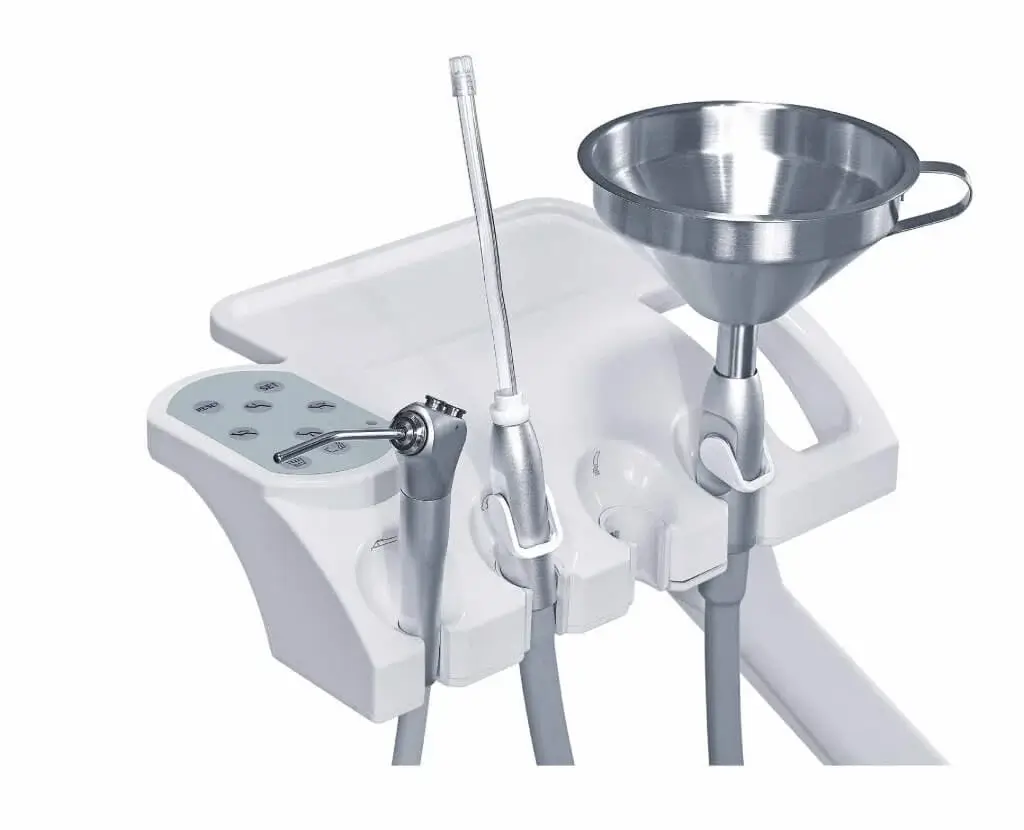 Suction, Irrigation, and Waste Control
Implant surgery often generates blood, saliva, irrigation fluid, and bone debris. The suction system should provide stable performance. Strong suction should help maintain a dry and visible surgical field. Weak suction should support patient comfort and routine fluid control.
The cuspidor and water system should be positioned conveniently. The structure should help reduce splashing and improve the cleanliness of the treatment area.
Implant surgery requires stable equipment. The chair should not shake, tilt unexpectedly, or create vibration during treatment. Mechanical stability supports surgical accuracy and patient confidence.
The base should support different patient body types. The structure should remain stable during raising, lowering, reclining, and returning. A floor-fixed design can provide strong stability in permanent treatment rooms. A hydraulic structure can provide smooth movement and strong load-bearing performance when properly engineered.
Chair movement should be quiet and controlled. Smooth motion reduces stress during long surgical appointments. Low vibration also helps protect the accuracy of implant preparation and placement.
Hygiene is a central requirement in implant surgery. The dental chair should support infection-control procedures through material choice, surface design, and internal waterline structure.
The upholstery should be easy to wipe and disinfect. Seamless or low-crevice surfaces help reduce residue accumulation. The backrest, headrest, armrest, tray handle, control panel, and assistant element should be designed with cleaning access in mind.
The dental unit should support clean water delivery and controlled suction pathways. Internal pipeline disinfection functions can improve hygiene management in clinics that perform surgical procedures. A dual-bottle or disinfectant-compatible water system can help separate clinical water use from disinfection procedures.
Patient comfort matters during implant surgery because anxiety can increase movement and reduce cooperation. The chair should help patients remain calm and physically supported during long appointments.
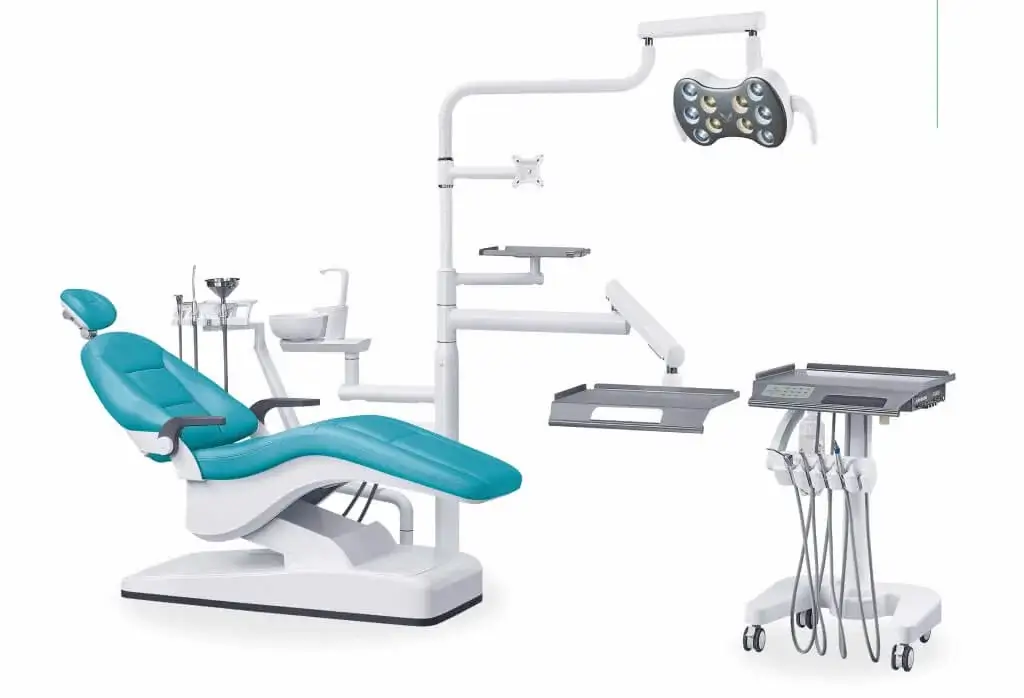 Cushion, Backrest, and Headrest Comfort
Soft cushion material can reduce pressure on the back and hips. A wide backrest can create a stronger sense of support. An adjustable headrest can reduce neck strain and keep the patient stable during drilling and suturing.
Implant surgery is generally longer than a typical restorative appointment. The chair should support the patient in a stable position for extended periods of time to allow for access to surgical sites without frequent repositioning of patient.
Dental clinics and distributors often require different chair configurations. Implant-focused clinics may prioritize surgical lighting, high-performance suction, stable delivery systems, and waterline hygiene. General clinics may require a broader balance between implant procedures, restoration, endodontics, and routine treatment.
The chair can be configured according to treatment type. Implant clinics may select a chair with an implant-oriented layout, detachable instrument areas, stable trays, and enhanced suction. Multi-specialty clinics may select hydraulic, disinfection, integral, floor-fixed, or mobile trolley configurations according to room layout and clinical workload.
Bulk buyers often evaluate consistency across multiple clinics. Matching chair models, control systems, spare parts, upholstery colors, and delivery layouts can simplify procurement and installation planning. Standardized configurations can also improve staff training across a clinic chain.
What type of dental chair is suitable for implant surgery?
For implant surgery, you would ideally like a dental chair that allows smooth movement and precise positioning. A strong suction system, suitable illumination, sufficient working space, and a chair’s surface that can be easily cleaned and is hygienic are also important. If you perform a lot of implant procedures in your clinic, an implant-type dental unit is usually the better choice.
Why is chair stability important during implant placement?
The stability of the chair is important when performing implant surgery. The precise drilling direction, the controlled hand movement of the surgeon and the patient in a fixed position all require a stable chair to allow for good surgical comfort and clinical control.
Gladent itself is a manufacturer, supplier, and factory located in Foshan, China, with product categories covering implant dental units, hydraulic dental units, disinfection dental units, integral dental units, kids dental units, floor-fixed dental units, mobile trailer dental units, dental handpieces, oil-free air compressors, suction products, curing lights, and dental accessories. Gladent supports B2B buyers with stable product quality, competitive pricing, CE-approved products, export experience across more than 50 countries, and long-term cooperation for dental equipment distribution and clinic projects. Contact Gladent and the team will provide professional product guidance, quotation support, and suitable dental equipment solutions for clinics, dealers, and project buyers.
 No. 1, No. 2, Fenggang Industrial Zone, Lianhe, Luocun, Shishan Town, Nanhai District, Foshan City, China
 Call us now:+86-757-81267151