When people plan, expand, or update a dental clinic, choosing the main equipment greatly affects daily work, treatment results, patient happiness, and future running costs. Among all items, the dental chair and the dental unit are often named together. Still, they belong to two quite different groups of dental equipment. Knowing their exact roles, structural differences, main features, and selection points helps clinic owners, equipment buyers, and dental supply sellers make smarter choices.
This detailed guide clearly explains the meanings, major features, important differences, and real-world selection tips for dental chairs versus dental units. It gives useful information for dental offices of different sizes.
What is a Dental Chair?
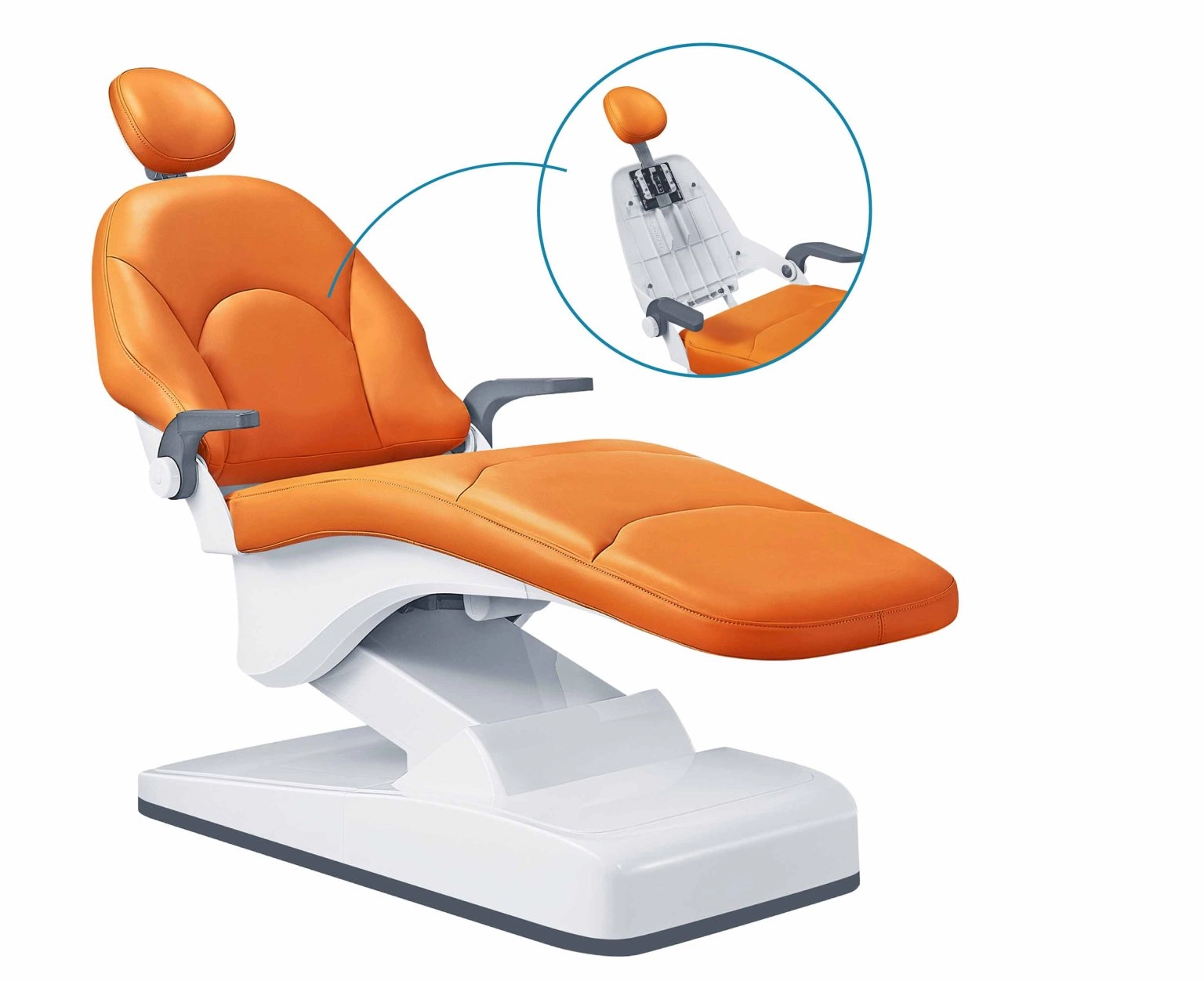
The dental chair remains the only piece of equipment that stays in direct, constant physical contact with the patient during almost the whole treatment. Its main job is to offer safe, pleasant, and well-suited body positions for patients of various ages, body shapes, and treatment requirements.
Modern mid-to-high-end dental chairs usually have these key technical features:
- Multi-axis electric or hydraulic movement system — includes seat height adjustment (normally 350–800 mm range), backrest tilt (0°–70°+), Trendelenburg position ability, and coordinated seat-tilt motion
- Programmable treatment positions — most chairs provide 3–9 memory spots (for example, entry/exit spot, upper jaw working spot, lower jaw working spot, last position recall)
- High-density memory foam + medical-grade seamless artificial leather — delivers comfort during long sessions and strong resistance to cleaning chemicals
- Built-in or optional patient comfort extras — heating system (seat and backrest), gentle start/stop movement, very quiet operation (<50 dB), double-articulating headrest
According to market groups, dental chairs generally fall into three main levels:
- Economy/basic level — mostly mechanical or simple electric control, 2–3 positions, good for very low-budget or short-term clinics
- Standard/mid-range level — complete electric control, 4–6 programmable positions, regular safety features, the most common choice for typical family clinics
- Premium/advanced level — hydraulic or top electric drive, 8+ memory positions, integrated operating light control, multimedia connection, luxury leather, frequently chosen for upscale private clinics, implant centers, and big international chains
Core Functions and Technical Evolution of Modern Dental Chairs
Over the past ten years, dental chair technology has changed a lot:
- From mechanical → electric → electro-hydraulic mixed drive
- From single motor control → multiple motors working together with smooth linked movement
- From fixed headrest → double-articulating headrest with many small adjustments
- From ordinary vinyl → antibacterial, stain-proof, seamless medical PU leather with heating option
- From purely mechanical controls → integration with central touch screen or foot controller
- From separate chair → more often the central base of a complete “integral dental unit”
Many companies now see the dental chair as the “skeleton” of the whole treatment setup. Delivery arms, assistant parts, operating lights, X-ray viewers, and multimedia systems all build around it.
What is a Dental Unit?
If the dental chair acts as the patient’s platform, then the dental unit works as the dentist’s main control center.
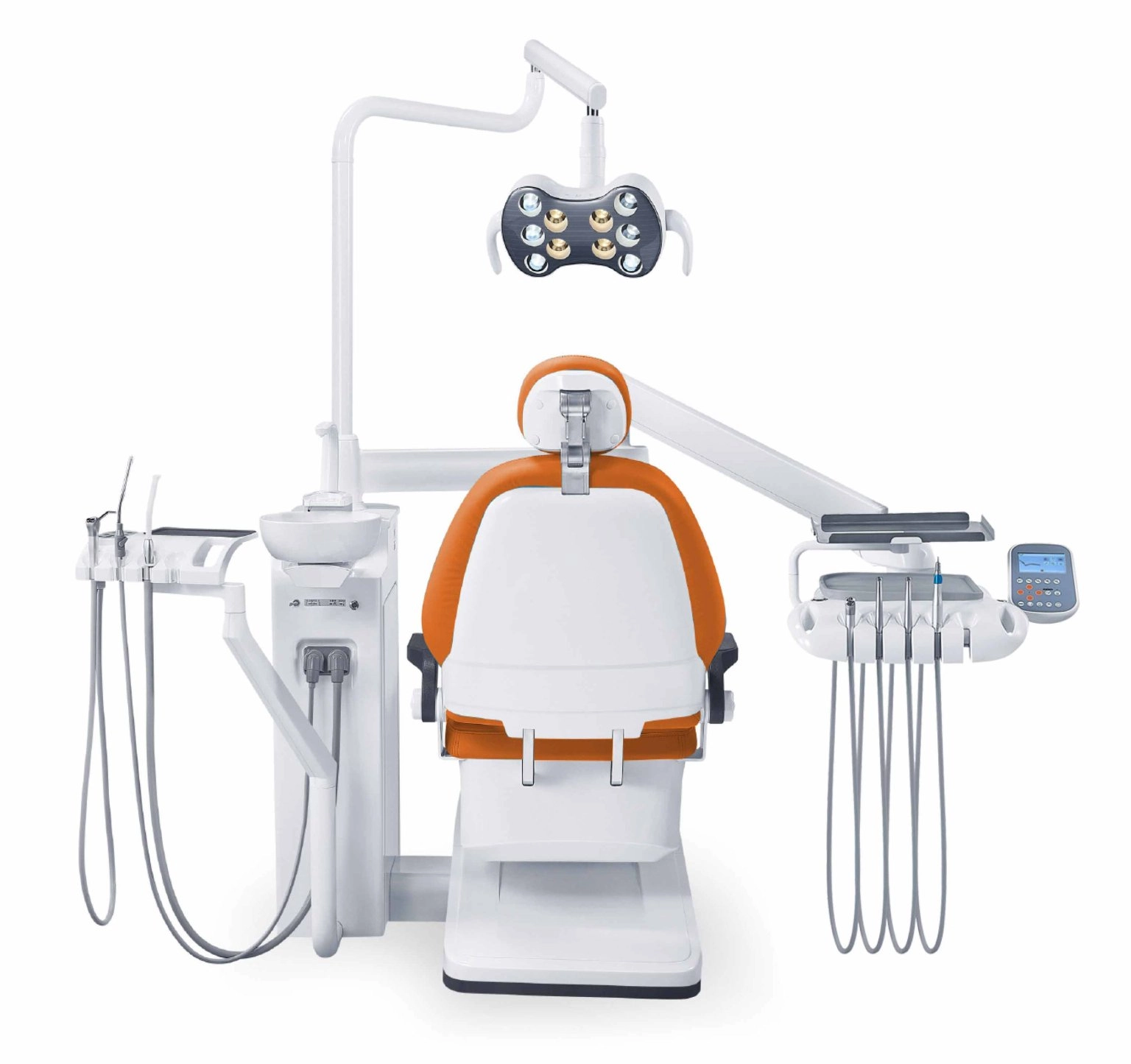
A full dental unit normally contains these important subsystems:
- Instrument delivery system (the most essential part)
- Hanging hose type / Side-arm type / Over-the-patient type
- 4–6 instrument holders (high-speed, low-speed, scaler, curing light, intraoral camera, etc.)
- Assistant element (support for 4-handed work)
- Strong & weak suction
- 3-way syringe (water/air)
- Assistant touchpad or control panel
- Water & air management system
- Self-contained water bottle or central water supply
- Separate water lines for each instrument
- Disinfection system (chemical or automatic waterline cleaning)
- Control system
- Foot controller (smooth speed adjustment)
- Touch screen / membrane panel on delivery unit
- Connection with chair control (in integral models)
- Optional high-end features
- Built-in electric scaler / LED curing light
- Fiber optic handpiece tubing
- Implant motor integration
- Multimedia monitor mounting arm
- Built-in intraoral camera system
- Central suction and compressor connection
At present, the market shows several popular dental unit designs:
- Traditional separate type (chair + side delivery unit)
- Top-mounted delivery (hanging hose above patient)
- Continental delivery (side arm type)
- Cart type / mobile unit (very flexible for rooms with multiple chairs)
- Integral / all-in-one type (chair + delivery + assistant element built together — currently the fastest-growing group)
Mainstream Types and Technical Architecture of Dental Units
In recent years, these clear trends have appeared:
- From side delivery → continental → integral design
- From air-driven → more electric motor handpieces
- From manual disinfection → automatic waterline disinfection system
- From analog control → digital touch interface + IoT monitoring
- From standard setup → modular upgrade options (implant, endodontic, pediatric, etc.)
Key Differences Between a Dental Chair and a Dental Unit
| Primary purpose |
Patient positioning & comfort |
Dentist operational tools & utilities |
| Main components |
Seat, backrest, legrest, headrest, base |
Delivery arm, handpiece tubings, suction, syringe |
| Movement system |
Multi-axis electric/hydraulic |
Mainly static (except delivery arm movement) |
| Control focus |
Patient position memory & comfort |
Instrument speed, water/air, suction strength |
| Hygiene difficulty |
Large surface area, seams challenging |
Complex water/air lines, more disinfection points |
| Upgrade path |
Usually replace whole chair |
Can upgrade handpieces, scaler, light separately |
| Price proportion |
45–60% of total operatory cost |
35–50% of total operatory cost |
| Lifespan expectation |
8–15 years (with regular maintenance) |
7–12 years (water lines & valves more vulnerable) |
Practical Selection Guide: Which Should Be Prioritized?
Different clinic types need different focus strategies:
- Small & medium-sized family clinics (2–5 chairs)Recommendation: First choose a reliable, mid-range integral dental unit Reason: Integral design gives better overall harmony, neater look, simpler maintenance, and stronger cost-performance balance.
- High-end private clinics / implant centersRecommendation: First choose premium chair + modular high-end unit Reason: Patients care about luxury comfort; doctors want maximum flexibility for different specialties.
- Pediatric / children-specialized clinicsRecommendation: Prioritize special pediatric chair (colorful, cartoon design, smaller size) Reason: Child cooperation presents the biggest challenge; the chair experience strongly influences treatment success.
- Budget-sensitive / startup clinicsRecommendation: Choose reliable mid-range integral model Reason: Avoid purchasing the cheapest separate parts that often cause ongoing maintenance troubles.
- Mobile / field dentistry / temporary clinicsRecommendation: Prioritize portable dental unit (suitcase type) Reason: Chair can stay simple or even folding style, but the unit must be highly integrated and easy to carry.
Typical Configuration Patterns in Different Types of Clinics
- Standard general clinic — mid-range integral unit + standard LED operating light + basic X-ray
- High-end cosmetic/implant center — premium chair + top-mounted delivery + implant motor + microscope arm + multimedia
- Pediatric clinic — cartoon pediatric chair + colorful integral unit + nitrous oxide system
- Endodontic specialist — premium chair + electric motor + apex locator integration + high-power suction
- Multi-chair chain clinic — mid-high integral units with centralized water, air, suction, and IoT monitoring
Conclusion
The dental chair and dental unit form the basic hardware foundation of every modern dental operatory. The chair mainly supports patient experience and accurate positioning. Meanwhile the unit directly affects treatment speed and doctor comfort. Understanding their real differences helps prevent wrong purchases and unnecessary spending.
In today’s market (2026), integral dental units that combine chair and delivery system in one smooth design have become the leading choice for most new clinics and upgrade projects. They provide the best mix of performance, appearance, maintenance, and cost.
FAQs
Q: Is an integral dental unit always better than separate chair + unit?
A: Not necessarily “better”, but for most standard clinics, integral models provide better overall coordination, cleaner look, easier installation, and usually stronger value for money.
Q: How many years can a good quality dental chair last?
A: With proper daily cleaning and yearly professional maintenance, 10–15 years is a realistic expectation for mid-to-high-end models.
Q: Which part fails most often in dental units?
A: Waterline blockage, solenoid valve failure, handpiece tubing aging, and foot controller contact issues are the most frequent problems.
Q: Can the same dental unit be used for both adults and children?
A: Technically yes, but pediatric-specialized chairs give much better child cooperation and treatment efficiency.
Q: Is it worth buying a chair with built-in heating and massage?
A: In high-end private clinics and areas with cold winters, yes — patients clearly notice and value these comfort features.
Ready to Source Reliable Dental Chairs & Integral Units?
As a professional dental chair manufacturer, integral dental unit factory, and global supplier, Gladent has focused on stable quality, competitive factory prices, on-time delivery, and flexible customization (including OEM/ODM services) for over 15 years.
We offer:
- Full range from economy to premium integral units
- Hydraulic & electric models
- Adult, pediatric, implant-specialized configurations
- CE/ISO certified products exported to over 50 countries
For bulk orders, distributor partnerships, clinic chain projects, or factory-direct quotations, contact the Gladent international team today:
- Phone: +86-757-81267151
- WhatsApp: +86 13543616157
- Email:gladent08@dental-chair.cn
- Official website:https://www.dental-unit.net/
Choose Gladent — reliable quality from factory to global clinics.
 No. 1, No. 2, Fenggang Industrial Zone, Lianhe, Luocun, Shishan Town, Nanhai District, Foshan City, China
 Call us now:+86-757-81267151